Sustainability regulations are rapidly changing the way plastic products are designed, sourced and marketed across Europe. For packaging and automotive applications in particular, regulations increasingly influence material selection, recycled content, and long-term product strategy. This page provides a practical overview of the most relevant sustainability regulations, explaining what they mean for your business today and in the future.
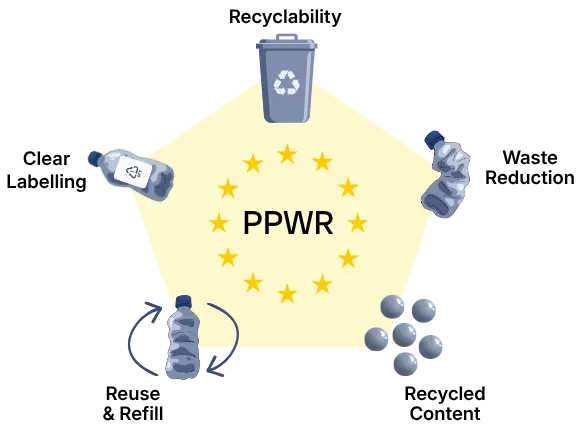
The Packaging and Packaging Waste Regulation (PPWR) introduces a harmonised approach to packaging design and waste management across the EU, requiring businesses to follow the same set of guidelines to do business in the European market.
The PPWR incentivises businesses to opt for packaging choices that consume less material, are less wasteful, more recyclable, clearly labelled, purposeful, and therefore encourage a circular economy. The PPWR mandates:
While the PPWR is being implemented gradually, over several years, most requirements are expected to become applicable from 2030 onwards.
The End-of-Life Vehicles Regulation (ELVR) is the EU's new framework that aims to reduce the environmental impact of vehicles and improve circularity across the vehicle lifecycle. It focuses on improving recyclability, limiting the use of hazardous substances, and increasing the recovery of materials, including plastics.
Unlike packaging regulations, the ELVR addresses long product lifecycles and complex material assemblies, making early design and material choices critical.
When it comes to materials, the ELVR requires greater use of post-consumer recycled (PCR) polymers, with a stronger focus on compatible materials that facilitate dismantling, recovery, and recycling. The ELVR mandates:
For automotive applications, the ELVR makes circular design and recycled-content planning more concrete. Material choices made today can affect future dismantling, recycling, traceability and recycled-content strategies, particularly for vehicle types approved from 2032 onwards.
In addition to EU-level regulations, many countries have introduced packaging taxes or fees linked to plastic use, recycled content and recyclability. These initiatives are designed to financially incentivise waste reduction and the use of recycled materials for a more circular economy. However, these initiatives vary significantly by country.
Sustainability regulations are introduced over several years, many with phased implementation. Understanding when different directives come into place is key for knowing when your product must comply.
The EU Deforestation Regulation requires manufacturers to ensure that raw materials, such as rubber, are traceable and verified as deforestation-free before being placed on the EU market.
The Packaging and Packaging Waste Regulation introduces harmonised rules for packaging across Europe, beginning with substance restrictions including PFAS and heavy metals.
All packaging must adhere to new labelling standards. Labels will have to meet certain criteria such as detailing material composition to enable efficient sorting and recycling of waste.
All packaging must be recyclable at scale, and optimised for reuse. The minimum recycled content requirements increase, with higher PCR thresholds applied to all packaging formats.
The Eco-design for Sustainable Products Regulation sets requirements for product durability, recyclability, and material transparency, while introducing digital product passports.
All vehicles approved from the 1st of September must include at least 15% recycled plastic. Vehicles must also be designed to enable the removal and replacement of certain parts.
Our technical and commercial team is available to discuss material requirements, recycled content targets, regulatory obligations, and supply feasibility.

11 The Valley Centre
Gordon Road
High Wycombe
Buckinghamshire
HP13 6EQ
United Kingdom