Resinex
Products
About
Sustainability
Contact
Register with us

Login
Sustainable Polymer Solutions
Recycled Polymers
Sustainable Polymer Solutions

PCR & PIR Mechanically Recycled Plastics

Post-consumer recycled (PCR) and post-industrial recycled (PIR) are the two main mechanical recycling routes available today. This process of collecting waste, sorting, washing, and re-granulating it into a processable form enables plastic waste to be diverted from landfill, export or incineration, and instead reused in new products.

PCR is essential for meeting packaging regulations such as the PPWR, while PIR often delivers better performance and consistency. The right choice depends on your application, regulatory goals, and performance requirements.

What is your sustainability target?

Selecting a material that supports your environmental green claims is tough, trading off between regulation, performance, availability and cost. Starting with your primary sustainability target helps identify which recycled solution is most appropriate, and where compromises may be needed.

White Plastic Bottle Icon

"I need to comply with the PPWR..."

To comply with the PPWR, you must incorporate post-consumer recycled (PCR) content to meet the mandatory recycled content thresholds...

White Electric Car Icon

"My OEM requires recycled content..."

If moving directly to PCR is challenging, post-industrial recycled (PIR) solutions enable recycled content without compromising too much...

White Carbon Footprint Icon

"I need to reduce my carbon footprint..."

Mechanically recycled, bio-circular and bio-based plastics offer lower cradle-to-gate GHG emissions than non-recycled virgin plastics...

White Light Bulb Icon

"I want a credible sustainability story..."

With the Green Claims Directive, credibility matters. Certification provides verified evidence of recycled-content attributes for external communication...

What is the difference between PCR and PIR plastics?

PCR and PIR are the two main mechanical recycling routes available today. While both reduce the use of virgin material, they differ in feedstock origin, performance consistency, and regulatory relevance.

Post-Consumer Recycled (PCR)

PCR plastics are made from waste collected after consumer use, such as packaging recovered from household waste streams. After collection, materials are sorted, shredded, washed, processed and compounded to achieve consistent properties.

Advantages:

  • Supports meeting regulations requiring recycled content (PPWR & ELV).
  • Reduced reliance on fossil-based resources.
  • Diverts waste away from landfill or incineration.
  • Contributes to a circular economy.

Disadvantages:

  • Colour, odour & properties can vary depending on feedstock quality
  • May require processing or performance additives to achieve the desired result in the end product.

Post-Industrial Recycled (PIR)

PIR plastics are derived from clean industrial scrap, rejects and waste generated during manufacturing processes. The mechanical recycling process followed is very similar to PCR but demands less intensive sorting, cleaning and compounding.

Advantages:

  • Can offer more consistent quality due to cleaner, more controlled feedstock.
  • Reduced risk of contamination compared to post-consumer waste.
  • Easier to integrate into existing production without major process changes.
  • Supports waste reduction in manufacturing processes.

Disadvantages:

  • Does not contribute to PCR content targets required by the PPWR and ELV.
  • Traceability and origin can mean reduced sustainability benefit with inability to make sustainable claims due to lack of reporting.
  • Less available than PCR.

Not all Recycled Plastics are Made Equal

Recycled polymers vary significantly depending on the origin of feedstock, how the feedstock is treated and how it's processed on the production lines. With recycled plastics, additional collection, sorting, and cleaning stages are required before the material can be remoulded. These steps are essential to ensure consistent quality, but they can also influence cost, availability and performance.

Recycled materials follow a different cost dynamic than prime polymers. While prime polymer pricing is largely driven by feedstock, the cost of PCR is dominated by processing, including sorting, cleaning and extrusion. As a result, recycled materials are less directly exposed to the commodity price volatility that makes prime polymer pricing difficult to predict. Although PCR can carry a price premium today, its cost base is more stable. For converters and brand owners, this predictability and reduced exposure to oil market swings can make recycled materials an attractive long-term option.

Understanding these differences is key when selecting the right material. Factors such as mechanical properties, visual requirements, regulatory targets, and supply stability all play a role in determining which polymer is suitable for your application.
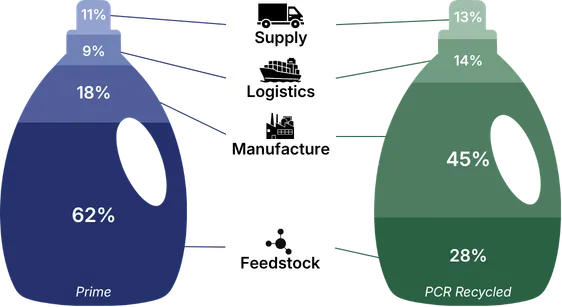
Prime vs PCR cost comparison

Graphic representing the cost contributions of each step in the supply chain for prime vs recycled polymers.

What is Chemical Recycling?

Chemical recycling of plastics uses technologies that break down plastic waste into molecular building blocks that can be used as new feedstock to produce new polymers with high purity. These processes can enable recycling where mechanical routes are not suitable, such as for food-contact and medical applications that have stringent regulations.

However, chemical recycling is energy-intensive and can result in a higher carbon footprint than mechanical recycling or even virgin materials, depending on the process and feedstock quality.

Today, chemical recycling is typically used where regulatory or purity requirements outweigh the necessity for carbon footprint improvement, whilst still ticking the circularity box.

Explore Recycled Polymers Available to you

Durethan®Envalior
PA6
PA(unspecified)
216 products
ZytelCelanese
PA66
PA66/6T
PA66/6
PA6
PA612
+1
146 products
LG Chem ABSLG Chemicals
ABS
MABS
126 products
Braskem PPBraskem
PP COPO
PP HOMO
PP RACO
69 products
Selenis PETSelenis
PETG
PET
CPET
TPC
56 products
RavapuraRavago Manufacturing
LDPE
ABS
PP Compounds
HIPS
HDPE
+1
36 products
EcomidCelanese
PA66
PA6
13 products
RevoloopDow
LLDPE
LDPE
3 products

Closed Loop Recycling

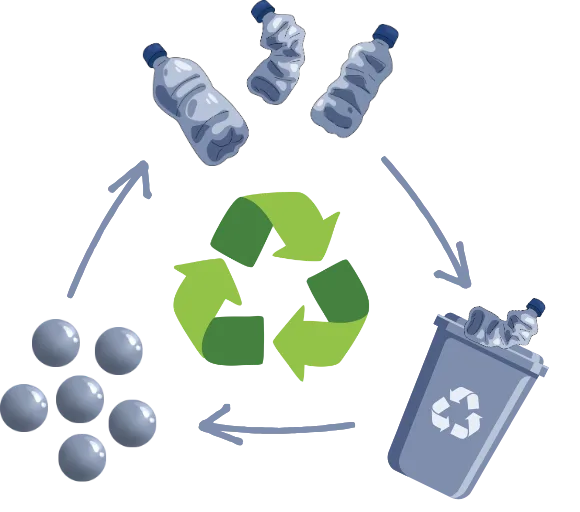
Closed loop recycling describes the process of recycling a product (e.g. a PET bottle), converting it back into granules (rPET), then re-moulding into the same product (a bottle) and continuing this process. Compared to open loop recycling, that uses mixed sources of recyclate, closed loop reuses the same material in the same application.

This approach opens doors to more demanding applications. By circulating the same feedstock, the risk of contamination is minimised and quality levels are kept high. This also enables some approvals to be achieved such as food approval.

However, this approach requires dedicated infrastructure with comprehensive return schemes. Consequently, a critical mass is needed to make closed loop recycling feasible and commercially viable.
What are the benefits of closed loop recycling?

  • A transparent and easy-to-understand value chain
  • A single source of feedstock maintains material quality

What are the drawbacks of closed loop recycling?

This approach to recycling requires dedicated infrastructure with comprehensive return schemes. Consequently, a critical mass is needed to make closed loop recycling feasible and commercially viable.

Circularity Graphic

Recycled Polymers: Frequently Asked Questions

Most thermoplastics can be recycled, but the practicality of recycling depends on the material type, local infrastructure, application, whether different polymer types are used in one product, and whether components can be separated for recycling.

Widely recycled plastics include polypropylene (PP), polyethylene (PE), polyethylene terephthalate (PET) and polystyrene (PS). More can be recycled, including polyamide (PA) and polycarbonate (PC), but for any plastic to be recycled, it must be separable from other materials (e.g, PA components must be separated from PP components), it mustn't be contaminated with hazardous substances and the collection and sorting infrastructure must be in place.

Products designed for recyclability, applying monomaterial design and design for disassembly principles, whilst using materials collected through established systems, are more likely to be recovered and reprocessed.


Post-consumer recycled content is waste material that comes from products after they have been used and disposed of by consumers, such as food packaging.

Post-industrial recycled content is production scrap, rejected parts, and offcuts from manufacturing. This material has not reached the shop shelves or the consumer and can also be called pre-consumer recycled content.

The content describes the amount of material that comes from the dedicated recycling stream as a percentage. The rest is from another material stream. This stream can be biobased, differently recycled, or virgin material and should be certified in a dedicated document. The remaining component can be virgin polymer or additives (colour, modification of properties and/or filler).


The Packaging and Packaging Waste Regulation (PPWR) mandates recycled content targets for different application groups. With the aim of increasing the use of recycled material and adopting a circular economy, the regulation demands a minimum percentage of post-consumer recycled content in the product.

Only post-consumer recycled (PCR) material contributes to this percentage.


Recycled plastics, in particular post-consumer recycled (PCR) plastics, can be more expensive than prime or virgin materials for a few reasons.

Rather than buying monomer, feedstock needs to be collected therefore costing more in infrastructure and logistics. The feedstock then requires sorting, shredding, washing and processing. Additional quality control and compounding steps incur further costs to ensure the resulting material is easily mouldable and achieves a good finish.

Post-industrial recycled (PIR) can be cheaper as the cleaning doesn't need to be as intense, and neither does the compounding. However, the cost varies depending on polymer type, supply agreements and market conditions.


Post-industrial recycled (PIR) and post-consumer recycled (PCR) solutions bring different benefits that suit different technical, regulatory and environmental objectives, so neither is inherently "better".

PIR typically offers more consistent quality and easier processing, but doesn't count to PPWR recycled content contributions and may not support the same recycled-content reporting or environmental attribute claims as PCR.

PCR supports regulatory compliance (PPWR and ELV) and recycled-content targets. It can still deliver excellent quality but to get this extra care is needed when selecting feedstock and care required in processing to prevent any degradation.


Some recycled materials can be used in highly regulated markets such as food and drink or medical. However, to meet the strict regulatory requirements (e.g. EFSA) using PCR or PIR, a closed loop system is often required, demanding dedicated infrastructure, critical mass and a seamless return scheme.

Currently, bio-attributed or chemically recycled materials are the preferred solution for highly regulated markets, whilst the infrastructure for PCR and PIR solutions is developed.


We saw the European recycling industry shrink in the past years due to cheap non-recycled virgin plastics. Now, recycled plastic supply is improving with greater incentives, appropriate labelling of products and ease of recycling. As regulations such as the PPWR increase demand for recycled content, we and many market participants expect supply chains to expand.

To ensure the stability of supply, it is best to work closely with your material supplier to understand their feedstock contracts and how robust their supply chain is. Ravago has strong relationships with feedstock suppliers, with extensive contracts enabling them to support supply continui


Get in touch

Speak to a Sustainable Polymer Specialist

Our technical and commercial team is available to discuss material requirements, recycled content targets, regulatory obligations, and supply feasibility.


Resinex
Information
ProductsAbout UsMarketsTechnologiesContactLegal DocumentsCode of ConductSales Terms & Conditions
Helpful Links
ServicesTerms of UsePrivacy PolicyCookie PolicyQuality StatementISO 9001 - CertificateImpressumCookie Preferences
RESINEX UK Limited
+441494459881

11 The Valley Centre
Gordon Road
High Wycombe
Buckinghamshire
HP13 6EQ
United Kingdom

info.uk@resinex.com

Ravago
Resinex. All rights reserved. Member of the Ravago Group