The European Commission's Bioeconomy Strategy aims to replace "fossil-based resources with sustainable biological ones for a circular, climate-neutral economy". Whilst recycled solutions offer one route, another is bio-materials.
Resinex has a long history of bringing bio-polymers to products in the European market. As pioneers in the field, we were among the first to introduce innovative solutions such as NatureWorks' INGEO® PLA (Polylactic Acid) and Braskem's "I'm Green™️" Green PE to customers. Since then, our portfolio has expanded to include Rilsan® bio-based PA 11, EcoPaXX® PA 4.10 and other engineering polymers.
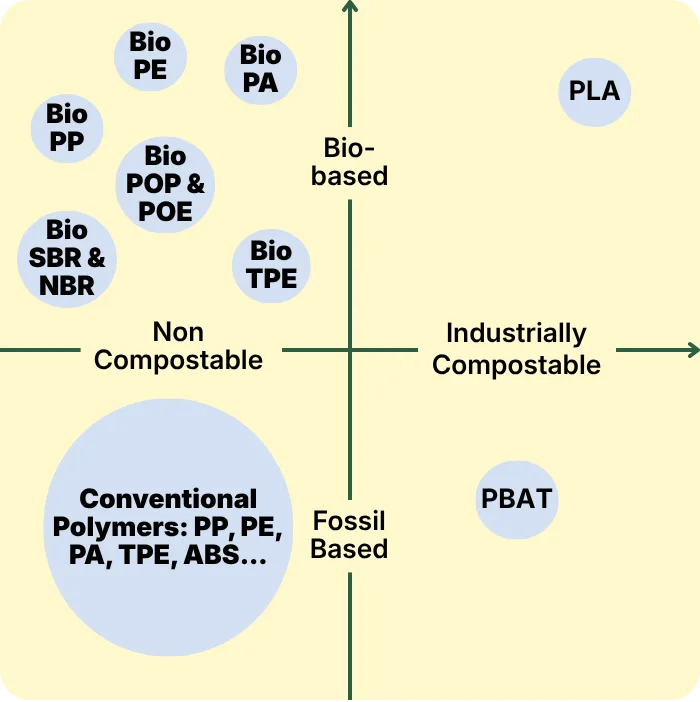
Bioplastics, or biopolymers, are a subgroup of biomaterials. Biomaterials can be derived from natural resources (e.g., agricultural waste and biomass) or fossil fuels, and can be compostable or non-compostable. The variety of these now available on the market means it is crucial to understand the types of biomaterials so that you know how they will behave and can make the right material choice for your product.
It is important to distinguish between these different biomaterials. Bio-based does not mean biodegradable, whilst compostable doesn't always mean home compostable. If in doubt, reach out to our team.

Describe incoming European bio-economy strategy to reduce consumption of fossil resources

With some bio materials, even a negative carbon footprint can be achieved*, especially with new bio-feedstocks such as bio-methanol

With bio-attributed or mass-balanced solutions, polymers can achieve identical performance to prime, providing a drop-in solution

Bio-attributed polymers can carry food contact and medical approvals for safety-critical applications
*Supplier LCA data indicates that significant CO₂e reductions be achievable with certain bio-based feedstocks, such as bio-methanol.Supporting environmental data for selected grades is available on request.
Bio-filled, also known as bio-reinforced polymers are conventional polymers combined with natural fibres or fillers such as wood, cellulose or other agricultural by-products. By replacing some of the fossil-based plastic content with natural fibres, the consumption of fossil content is reduced, while maintaining the processing advantages of thermoplastics.
This approach enables producers to integrate renewable or biogenic content into applications without fully transitioning away form familiar polymers. Some bio fillers or fibres can also provide functional benefits, improving stiffness, dimensional stability and giving a distinctive surface finish.
Our technical and commercial team is available to discuss material requirements, recycled content targets, regulatory obligations, and supply feasibility.

11 The Valley Centre
Gordon Road
High Wycombe
Buckinghamshire
HP13 6EQ
United Kingdom